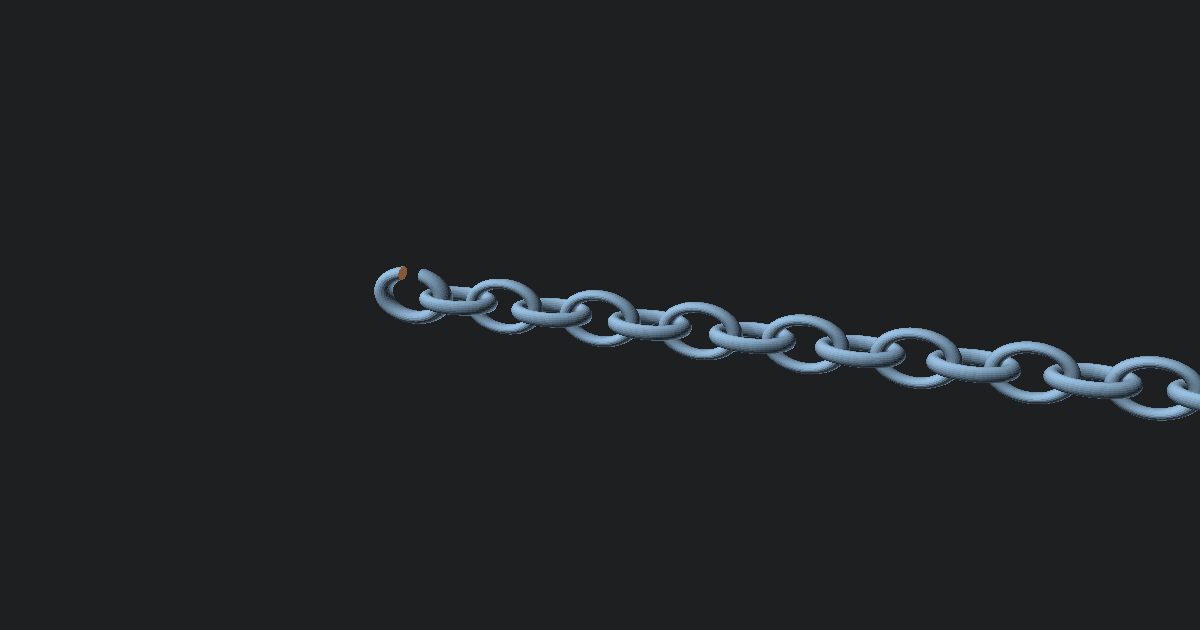
The little metal chain inside my toilet tank, the one that links the flush lever to the flapper, finally rusted through. Two dollars at the hardware store, tops. But I have a 3D printer, and every maker knows the real running cost of a printer isn't filament, it's the ongoing project of justifying it to your spouse. So, no, I was not going to the hardware store. I was going to print a chain.
What it actually is
It's a print-in-place chain. One print, no assembly, the links come out of the printer already interlocked. There's an open C-hook on each end: the top one drops onto the flush-lever arm, the bottom one hooks the flapper tab and lifts it when you push the handle.
The trick to printing it is that it lays flat on the bed and needs no supports. Every other link sits flat (those print perfectly and anchor the whole chain down), and the links between them stand up on edge and bridge their own top arc. Lay it diagonally on the plate, add a brim so the standing links don't wobble loose, and that's the whole setup.
Or at least, that's how it works now.
The hard part: it printed as a solid brick
First print came off the bed beautiful, and completely fused. Not a chain. A single rigid rod with chain-shaped texture. Zero links moved.
Here's why, and it's a good lesson in print-in-place. For two links to print as separate parts, there has to be a real air gap between them, bigger than what your nozzle can lay down, usually 0.4 mm or more. If the gap is smaller than that, the slicer just bridges across it and welds the two links into one solid body.
My design had a clearance parameter for exactly this. It sat right there at
the top of the file. The problem: I'd declared it and never actually used it
anywhere in the geometry. A dead variable. So the real gap between links was
whatever fell out of the raw spacing, which turned out to be under 0.2 mm. Way
too tight. The printer did exactly what I told it to and glued everything
together.
The fix
The fix was to make clearance mean something. Instead of trying to space the
links further apart, I thinned each link's wire by half the clearance on every
side, while keeping the links in the same spots. That pushes every neighboring
surface back, so the gap between any two links opens up by the full clearance
value. The wire gets a little thinner, which matters not at all when the job is
lifting a rubber flapper.
I checked it before reprinting by growing one link in software and confirming it no longer collided with its neighbor until I'd grown it past 0.4 mm. Real gap, verified. Reprinted, and this time every link flexed free off the bed.
Did it flush
It flushes. I hooked the top onto the lever arm, the bottom onto the flapper, left a little slack so the flapper still seats and seals, and that was it. White printed chain, doing the exact job the rusty metal one used to, except this one won't rust and I can print another in twenty minutes.
Total cost: about fifty cents of filament and one dumb bug.
The printer, I am pleased to report, is now officially justified. At least until the next thing breaks.